DOI: 10.12890/2026_007584
When cancer therapy suppresses the marrow: immune-mediated neutropenia following durvalumab therapy in cholangiocarcinoma
Authors

Keywords
Durvalumab, agranulocytosis, neutropenia, immune checkpoint inhibitor, cholangiocarcinomaAbstract
Introduction: Hematologic immune-related adverse events associated with immune checkpoint inhibitors are uncommon but may be life-threatening. Severe neutropenia and agranulocytosis are particularly challenging to diagnose in patients receiving concomitant cytotoxic chemotherapy.
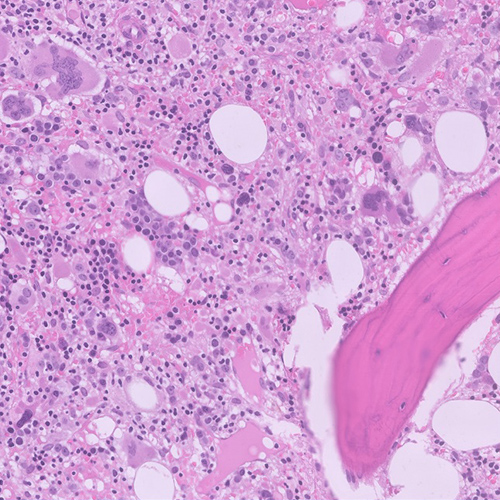
Case description: A 53-year-old woman with advanced cholangiocarcinoma developed febrile agranulocytosis with an absolute neutrophil count (ANC) of 0/µl after two cycles of gemcitabine, oxaliplatin, and durvalumab. Extensive infectious investigations were negative. Despite broad-spectrum antibiotics and granulocyte colony-stimulating factor, the ANC remained 0/µl for 20 days. High-dose corticosteroids produced no response. Bone marrow biopsy demonstrated severe granulocytic hypoplasia without malignant infiltration, with relative preservation of erythroid and megakaryocytic lineages, supporting an acquired immune-mediated marrow process. Treatment with cyclosporine followed by eltrombopag resulted in hematologic recovery, with ANC exceeding 1000/µl within 10 days of initiating cyclosporine.
Conclusion: Severe agranulocytosis should be considered in patients receiving immune checkpoint inhibitors who develop persistent neutropenia that is disproportionate to the expected effects of chemotherapy. Bone marrow evaluation may help distinguish immune-mediated marrow suppression from chemotherapy-related cytopenia. Early hematologic assessment and individualized treatment may be beneficial in steroid-refractory cases.
References
- Oh DY, Ruth He A, Qin S, Chen LT, Okusaka T, Vogel A, et al. Durvalumab plus Gemcitabine and Cisplatin in Advanced Biliary Tract Cancer. NEJM Evid. 2022;1(8):EVIDoa2200015. doi: 10.1056/EVIDoa2200015.
- Jalil A, Zaffar J, Waqas A, Butt S. Isolated Neutropenia Due to Immune Checkpoint Inhibitors. Cureus. 2023;15(9):e45674. doi: 10.7759/cureus.45674.
- Lee HT, Lee JY, Lim H, Lee SH, Moon YJ, Pyo HJ, et al. Molecular mechanism of PD-1/PD-L1 blockade via anti-PD-L1 antibodies atezolizumab and durvalumab. Sci Rep. 2017;7(1):5532. doi: 10.1038/s41598-017-06002-8.
- Grinsztejn E, Perez JA, DeSouza SI. Immunotherapy-Related Hematological Adverse Events: Incidence and Outcomes. Blood [Internet]. 2023;142(Supplement 1):2368. doi: 10.1182/blood-2023-180370.
- Petrelli F, Ardito R, Borgonovo K, Lonati V, Cabiddu M, Ghilardi M, et al. Haematological toxicities with immunotherapy in patients with cancer: a systematic review and meta-analysis. Eur J Cancer. 2018;103:7-16. doi: 10.1016/j.ejca.2018.07.129.
- Kitamura Y, Shimizu S, Kuroda S, Honmyo N, Nakano R, Sakai H, et al. Durvalumab induced immune-related agranulocytosis after conversion surgery in a patient with intrahepatic cholangiocarcinoma: a case report. Front Immunol. 2025 Jul;16:1610190. doi: 10.3389/fimmu.2025.1610190.
- Kalaci E, Ürün Y. Nivolumab-induced immune-related neutropenia in a renal cell carcinoma patient. J Oncol Pharm Pract. 2023;29(7):1797-1801. doi: 10.1177/10781552231186748.
- Naqash AR, Appah E, Yang LV, Muzaffar M, Marie MA, Mccallen JD, et al. Isolated neutropenia as a rare but serious adverse event secondary to immune checkpoint inhibition. J Immunother Cancer. 2019;7(1):169. doi: 10.1186/s40425-019-0648-3.
- Boegeholz J, Brueggen CS, Pauli C, Dimitriou F, Haralambieva E, Dummer R, et al. Challenges in diagnosis and management of neutropenia upon exposure to immune-checkpoint inhibitors: meta-analysis of a rare immune-related adverse side effect. BMC Cancer. 2020;20(1):300. doi: 10.1186/s12885-020-06763-y.
- Delanoy N, Michot JM, Comont T, Kramkimel N, Lazarovici J, Dupont R, et al. Haematological immune-related adverse events induced by anti-PD-1 or anti-PD-L1 immunotherapy: a descriptive observational study. Lancet Haematol. 2019;6(1):e48-e57. doi: 10.1016/S2352-3026(18)30175-3.
- Michot JM, Lazarovici J, Tieu A, Champiat S, Voisin AL, Ebbo M, et al. Haematological immune-related adverse events with immune checkpoint inhibitors, how to manage? Eur J Cancer. 2019;122:72-90. doi: 10.1016/j.ejca.2019.07.014.
- Kroll MH, Rojas-Hernandez C, Yee C. Hematologic complications of immune checkpoint inhibitors. Blood. 2022;139(25):3594-3604. doi: 10.1182/blood.2020009016.