DOI: 10.12890/2026_007319
Brain abscesses caused by Tsukamurella pulmonis: A rare presentation of an unusual microorganism
Authors

Keywords
Tsukamurella pulmonis, brain abscesse, catheterrelated bacteremia, immunocompentent host, pulmonary infectionAbstract
Introduction: Tsukamurella pulmonis is a rare aerobic Gram-positive actinomycete that most commonly causes catheter-related bloodstream infections in immunocompromised patients. Central nervous system involvement is exceptionally uncommon, and its microbiological resemblance to other aerobic actinomycetes frequently delays diagnosis and appropriate treatment.
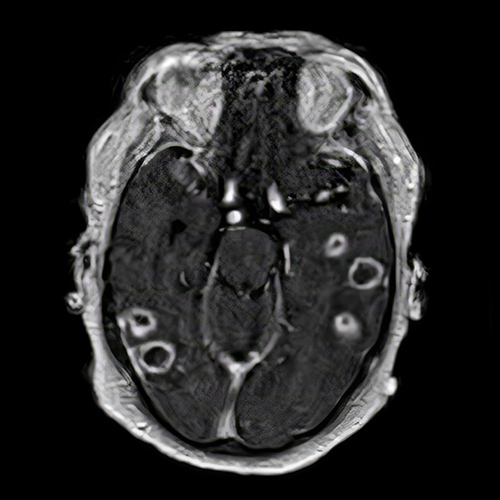
Case description: We report the case of a 75-year-old man with no relevant past medical history and a recently identified pulmonary hilar lesion who presented with fever and progressive confusion. The initial cranial computed tomography scan was unremarkable, but subsequent brain magnetic resonance imaging revealed multiple supra- and infratentorial brain abscesses. Bronchoscopic biopsy of the pulmonary lesion demonstrated necrotizing granulomatous inflammation, while microbiological analysis identified Tsukamurella pulmonis. Echocardiography ruled out infective endocarditis. The patient received intravenous meropenem combined with high-dose trimethoprim-sulfamethoxazole, followed by oral trimethoprim-sulfamethoxazole after 4 weeks because of marked clinical and radiological improvement. Apart from transient leukopenia, treatment was well tolerated. Despite successful control of the infection, the patient died 4 days after discharge following an episode of bronchoaspiration unrelated to progression of the infection.
Conclusion: This case highlights the importance of considering T. pulmonis in the differential diagnosis of invasive infections with atypical clinical and radiological findings, even in immunocompetent patients. It also emphasizes the pivotal role of advanced microbiological techniques for accurate species identification and demonstrates that prolonged targeted antimicrobial therapy may achieve favorable radiological and clinical responses despite the absence of standardized treatment recommendations.
References
- Leroy AG, Persyn E, Guillouzouic A, Ruffier d’Epenoux L, Launay E, Takoudju EM, et al. Catheter-related bloodstream infection due to Tsukamurella pulmonis identified by MALDI-TOF spectrometry, 16S rRNA gene sequencing, and secA1 gene sequencing in an immunocompromised child: a case report and literature review. Diagn Microbiol Infect Dis. 2020;97(3):115052. doi: 10.1016/j.diagmicrobio.2020.115052.
- Suzuki J, Sasahara T, Toshima M, Morisawa Y. Peripherally inserted central catheter-related bloodstream infection due to Tsukamurella pulmonis: a case report and literature review. BMC Infect Dis. 2017;17(1):677. doi: 10.1186/s12879-017-2796-8.
- Leung KCP, Au SCL, Ko TCS. Ophthalmic manifestation of Tsukamurella species: case series and first report of ocular implant infection after enucleation. Cornea. 2019;38(10):13281331. doi:10.1097/ICO.0000000000001997.
- Malik Z, Shah PJ, Tariq F. First report of Tsukamurella endocarditis in an immunocompromised patient receiving chemotherapy. Eur J Clin Microbiol Infect Dis. 2020;39(10):19891991. doi:10.1007/s10096-020-03917-5.
- Maalouf R, Mierau SB, Moore TA, Kaul A. First case report of communityacquired pneumonia due to Tsukamurella pulmonis. Ann Intern Med. 2009;150(2):147148. doi:10.7326/0003-4819-150-2-200901200-00022.
- Woo PCY, Ngan AHY, Lau SKP, Yuen KY. Tsukamurella conjunctivitis: a novel clinical syndrome. J Clin Microbiol. 2003;41(7):33683371. doi: 10.1128/JCM.41.7.3368-3371.2003.
- Perez VA, Swigris J, Ruoss SJ. Ruoss SJ. Coexistence of primary adenocarcinoma of the lung and Tsukamurella infection: a case report and review of the literature. J Med Case Reports. 2008;2:207. doi:10.1186/1752-1947-2-207.